Crete’s monasteries are not quick roadside photo stops. They are working religious sites, places of memory and often the reason a mountain or coastal drive becomes the best part of your holiday. This selection of the 10 most unique monasteries of Crete is for travellers who want more than another beach day - and who want clear, realistic advice before setting off.
Some are easy additions to a route from Heraklion or Chania. Others sit behind long stretches of mountain road, where having your own car gives you the freedom to arrive early, stop where you like and leave without chasing the last bus. Dress respectfully, allow extra time for the drive, and always check local opening arrangements before you go.
10 most unique monasteries of Crete
1. Arkadi Monastery - the island’s defining memorial
Arkadi, southeast of Rethymno, is one of Crete’s essential visits because its beauty and history are inseparable. Its elegant Venetian-style façade, with carved columns and a balanced central bell tower, looks more like a Renaissance church than a remote Cretan monastery.
Behind it is a much heavier story. In 1866, during the Cretan revolt against Ottoman rule, hundreds of people sheltering here died after the monastery’s powder magazine exploded. Arkadi became a symbol of resistance across Greece. Visit for the architecture, but give the small museum and memorial spaces proper time. This is not a place to rush through between lunch and the beach.
The drive from Rethymno is straightforward, making Arkadi a good first monastery for families or anyone uneasy about narrow roads.
2. Preveli Monastery - where mountains meet the Libyan Sea
Preveli is actually associated with two monastery complexes in southern Rethymno, but the lower monastery, Piso Preveli, is the one most visitors mean. It stands on a hillside above the dramatic southern coast, surrounded by olive groves and views that reach towards the Libyan Sea.
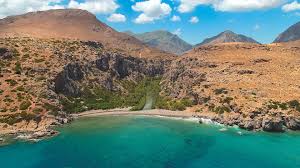
Its historical importance includes its role in helping Allied soldiers escape Crete during the Second World War. The setting, though, is what makes it exceptional. Combine the visit with the nearby palm-lined Preveli Beach if you want a full day out, but plan your order carefully. The beach approach can involve a steep walk, and the midday heat is unforgiving.
This is a route where a small or medium car is often more comfortable than a large vehicle. The roads are scenic but winding, and fuel stations are less frequent than on the north coast.
3. Toplou Monastery - a fortress near Vai
Toplou Monastery, in eastern Crete near Sitia, has the scale and defensive character of a small fortress. Thick stone walls, a tall bell tower and a substantial courtyard reflect a period when coastal monasteries needed protection from pirate raids and invading forces.
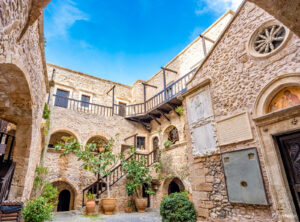
It is also known for its icon collection and its ties to local agriculture, including wine and olive oil production. Toplou is a strong choice for travellers staying in Agios Nikolaos, Elounda or Sitia who want to see a different side of Crete from the busier west.
Pair it with Vai Palm Forest and the beaches of the far east, but do not underestimate the distances. From Heraklion, this is a proper day trip, not a casual detour. Leave early and return before dark if you are not used to rural Cretan roads.
4. Agia Triada Tzagarolon - calm, order and olive groves
On the Akrotiri Peninsula outside Chania, Agia Triada Tzagarolon feels remarkably composed. Built in the 17th century by Venetian monks from the Tzagarolon family, it has a symmetrical courtyard, pale stone arcades and a domed church that gives the whole complex a quiet grandeur.
The monastery produces olive oil and wine, and the landscape around it is part of the appeal. It is easy to combine with Chania Airport arrivals, the Venetian old town, or a drive to the beaches of northern Akrotiri.
This is one of the simplest monastery visits to build into a Chania itinerary. Even so, avoid treating it as a drive-by stop. The atmosphere rewards a slower visit, particularly in the morning before the peninsula gets busy.
5. Gouverneto Monastery - a stone gateway to Avlaki Gorge
Further out on Akrotiri, Gouverneto Monastery is more austere than Agia Triada and all the more striking for it. Its fortress-like entrance is framed by carved stone animals and saints, while the enclosed courtyard has a severe, almost monastic simplicity.
What makes Gouverneto especially memorable is the walk beyond it. A path descends through Avlaki Gorge towards the abandoned cave monastery of Katholiko, one of the oldest monastic sites on Crete. The trail is uneven and exposed, so proper shoes, water and sensible timing matter. It is not suitable for everyone in high summer.
Access and opening conditions can change, particularly because this is an active religious area. If the gate is closed, respect it. Do not park carelessly or try to force a visit around local restrictions.
6. Kera Kardiotissa - the mountain monastery of miracles
Kera Kardiotissa, near Kera village on the road between Heraklion and Lasithi Plateau, is smaller than Arkadi or Toplou but deeply atmospheric. It is dedicated to the Virgin Mary and has long been associated with a miraculous icon, drawing pilgrims from Greece and abroad.
The monastery’s whitewashed walls, small chapel and mountain backdrop make it an easy, rewarding stop on a Lasithi day trip. It works particularly well with the villages of Krasi and Mochos, where you can take a break before continuing uphill.
The trade-off is traffic. This route is popular in summer, and coach tours can arrive at the same time. Go earlier in the day for a quieter experience and easier parking.
7. Vrondisi Monastery - remarkable fountains in the Psiloritis foothills
Vrontisi Monastery lies on the southern slopes of Mount Psiloritis, southwest of Heraklion. It is best known for its extraordinary 17th-century marble fountain, decorated with sculpted figures and animal heads. Few Cretan monasteries have such an unusual surviving piece of stonework.
The surrounding area adds to the visit. You are in the heart of rural Crete, with vineyards, olive trees and roads that lead towards Zaros, the Rouvas Forest and the Messara plain. This is a good choice for travellers who have already seen the headline sites and want somewhere less crowded.
Roads are generally manageable, but routes through inland villages take longer than map distances suggest. Build slack into your plan rather than booking a tight restaurant or boat departure afterwards.
8. Odigitria Monastery - a fortress on the Messara plain
Odigitria Monastery sits south of Heraklion, not far from the route towards Matala and the south coast. Dating back centuries, it has defensive walls, a peaceful courtyard and a tall stone tower known as the Tower of Xopatera.
Its location makes it practical as well as distinctive. You can combine it with Phaistos, Matala, the beach at Kommos or the quieter roads towards the Asterousia Mountains. That combination gives you archaeology, local villages and coastline in one day without repeatedly crossing the island.
The final approach is rural, and signage can be limited. A charged mobile phone and offline map access are sensible precautions. More importantly, keep your speed down through villages and on bends - goats and slow farm vehicles are part of the route.
9. Panagia Kaliviani - a living community near Mires
Near Mires in the Messara region, Panagia Kaliviani is different from the isolated, defensive monasteries on this list. It is a large, active religious community with social and charitable work at its core, including care and education services alongside the monastery itself.
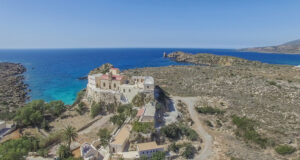
The gardens and church make for a peaceful visit, but the real distinction is its living role in the local community. It feels less like a preserved monument and more like a place with daily purpose.
Visit with a quiet, respectful attitude. Religious services, local visitors and community activities take priority over sightseeing. This is a natural stop if you are travelling between Heraklion, Phaistos and Matala.
10. Chrysoskalitissa Monastery - white walls above the west coast
Chrysoskalitissa, near Elafonissi in western Crete, stands on a rocky rise above the sea. Its name means “Our Lady of the Golden Steps”, referring to the local legend that one of the steps leading to the monastery is made of gold but visible only to the truly faithful.
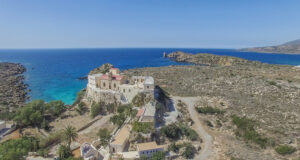
Whether or not you believe the story, the setting is unforgettable. Whitewashed buildings, blue water and the rugged western landscape create one of Crete’s most photogenic monastery stops. It is easy to add to an Elafonissi trip, but that does not mean the day will be easy. The road is long, busy in peak season and includes bends that demand patience.
Start from Chania early, take breaks, and do not rely on rushing back after sunset. A self-drive day in western Crete is far more enjoyable when the timetable is realistic.
Practical rules for monastery visits in Crete
Monasteries are religious sites first and visitor attractions second. Shoulders and knees should be covered, and some monasteries provide wraps at the entrance. Keep voices low, ask before photographing people, and do not assume every chapel or courtyard is open to visitors.
For driving, avoid trying to fit three distant monasteries into one day. Crete is larger and more mountainous than many first-time visitors expect. Choose one main site, add one nearby village, beach or archaeological stop, and leave room for viewpoints and delays. With a local rental from AthensCars, the useful part is simple: collect near your arrival point, pay on arrival, and travel at your own pace without building the day around a group transfer.
The best monastery day is rarely the one with the most pins on the map. Pick the place that matches your route, arrive with time to spare, and let the road through Crete do some of the work.