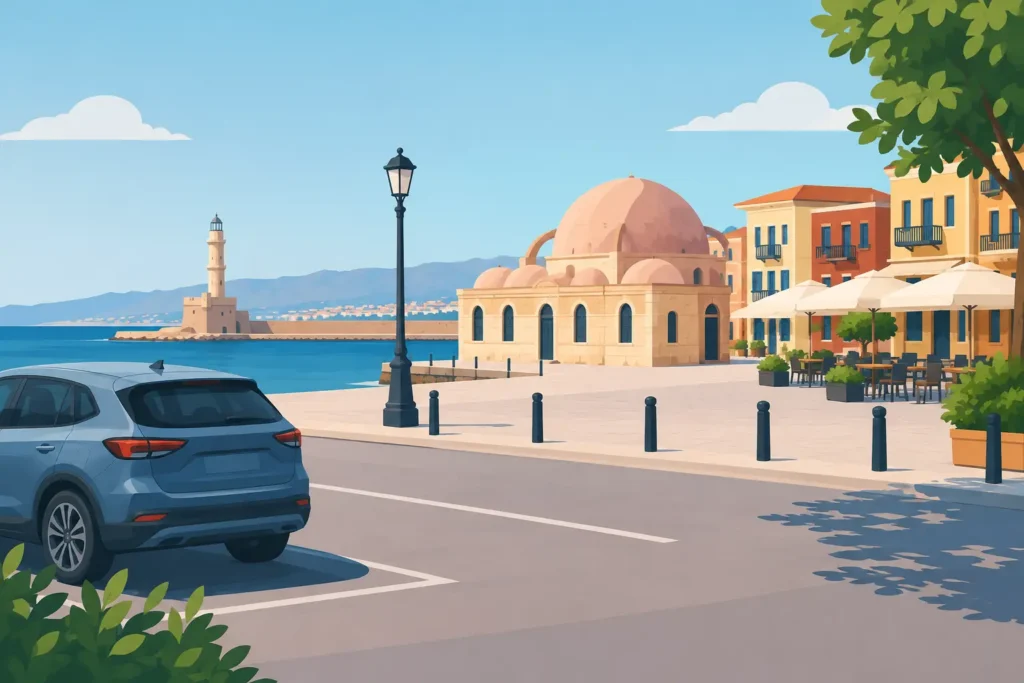
Talos Square sits at one of the most appealing edges of Chania’s Venetian Old Town: close to the harbor, the lighthouse walk, Firkas Fortress, and narrow streets that were not designed for modern traffic. That is exactly why parking in Chania Old City - Talos Square needs a plan before you arrive. Treat the car as transport to the edge of the old town, not as something you will drive through once you are there.
For travelers collecting a rental car at Chania Airport, arriving by ferry, or moving between hotels around Crete, this small bit of preparation prevents the most common first-day frustration: circling tight streets with luggage while every space looks taken.
What to Expect Near Talos Square
Talos Square is on the western side of the old harbor, near the entrance to the pedestrian-focused historic center. It is a convenient area for staying near the harbor, but convenience on foot does not always mean convenient vehicle access.
Street parking close to the square can be limited, particularly from late morning through the evening in the main travel season. Spaces may be used by residents, hotel guests, restaurant staff, and visitors stopping for the harbor. Some streets are narrow, one-way, restricted, or simply difficult to use with an unfamiliar car.
Do not assume that a visible open space is legal. Read the sign at the exact location, not the sign you passed a block earlier. Parking restrictions, paid-parking terms, resident spaces, loading zones, and access rules can change by street and season. If signage is unclear, choose a clearly marked lot instead of risking a fine or a blocked vehicle.
The practical trade-off is simple: the closer you park to the harbor, the more time you may spend finding a space. Parking a short walk away is often faster, easier, and far less stressful.
The Best Arrival Plan for Talos Square
If your accommodation is near Talos Square, contact it before driving into the area. Ask one direct question: where should guests park, and can we stop briefly for luggage? Many properties in the old town have no private parking, but they can usually tell you the closest practical approach road and whether a taxi-style drop-off is possible.
Arrive with your navigation set to a parking area or a major approach road, not only to the hotel entrance. GPS can lead drivers down lanes that are technically passable but unpleasant, crowded, or subject to restrictions. The final few hundred yards matter most in Chania Old Town.
A sensible routine is to reach the area, make one calm pass for a legal space, then move to a nearby marked parking option if nothing is available. Avoid repeated loops. They consume time, create pressure, and increase the chance of brushing a mirror on a narrow street or turning into a road you should not use.
If you are traveling with children, heavy suitcases, or a lot of beach equipment, drop passengers and luggage only where stopping is permitted and safe. Then have one driver park the car. It is usually much easier than trying to keep everyone inside while searching for a space.
Timing makes a real difference
Early morning generally gives you the best chance of finding nearby parking. Late afternoon and evening can be harder, especially when visitors arrive for dinner around the harbor. Weekend patterns, events, and summer demand can also affect availability.
If you have flexibility, do your driving days early. Return to your parking area before the old town gets busy, then explore Talos Square, the harbor, and the lanes around them on foot. Chania is better experienced that way anyway.
Parking Rules That Are Worth Taking Seriously
Old-town parking is not the place to take shortcuts. Never block a driveway, gate, intersection, sidewalk ramp, or narrow through route. Even if other cars appear to be parked badly, that does not make the space safe or permitted.
Pay attention to curb markings, road signs, parking-machine instructions, and time limits. If payment is required, keep proof of payment as instructed. Do not park in a space reserved for disabled drivers unless you have the required permit, and do not leave the car in a loading area because you only plan to be away for a few minutes.
Chania’s old center also has many areas where pedestrians have priority. A vehicle can be legal on the approach road but unwelcome or prohibited farther inside. When in doubt, stop before the tightest streets and walk the rest of the way.
This protects more than your vacation schedule. A ticket, towing issue, or vehicle damage can turn a simple harbor visit into an expensive problem. Clear rules and careful parking are always the lower-risk choice.
Choose the Right Car for Chania
For a stay near Talos Square, a compact car is often the most practical option. It is easier to position, easier to park, and more comfortable on Crete’s older streets and village roads. A larger vehicle may be useful for a big family or several large suitcases, but it comes with a real trade-off in historic areas.
That does not mean you need to avoid a larger car if your itinerary requires it. Just plan to use larger public parking areas and walk farther into the old town. Do not choose a vehicle based only on airport luggage capacity if you will spend several nights in Chania’s historic center.
At AthensCars, the straightforward approach is to match the vehicle to the trip, not just the lowest online rate. Travelers who want to explore beaches, mountain villages, and western Crete need reliable mobility, but they also need to know where a car is useful and where it is better left parked. Clear pricing and comprehensive coverage help, but careful driving and legal parking still matter.
Use Your Car for Crete, Not for Every Chania Errand
Once you are parked near Talos Square, leave the car there for the old town. The Venetian Harbor, Maritime Museum area, restaurants, shops, and waterfront are all best handled on foot. Trying to move the car from one old-town stop to another rarely saves time.
Save the car for the trips that make a rental worthwhile: Seitan Limania, Marathi, Balos access routes, Elafonissi, Falassarna, the Botanical Park, mountain villages, and the wider west coast. Before heading out, check your planned route, fuel level, weather, and return timing. Then come back with enough daylight to park calmly if you are returning during a busy period.
For a short stay, it can also make sense to collect the rental car after your old-town nights rather than immediately on arrival. This depends on your itinerary. If you are spending two days entirely in central Chania, walking and taxis may be easier. If you are heading out to beaches or villages the next morning, arranging airport, port, or hotel delivery can keep the transition simple.
If You Cannot Find Parking Nearby
Do not let a full area push you into an illegal space. Move away from the most congested harbor streets and look for clearly designated public parking within a reasonable walking distance. A 10- to 15-minute walk with a legal parking space is better than an anxious night wondering whether your vehicle will still be there in the morning.
Take a quick photo of the vehicle after parking, including its position and any nearby signs. This is especially useful with a rental car. Lock the vehicle, keep valuables out of sight, and do not leave passports, electronics, or bags visible inside. Crete is welcoming, but basic travel habits still apply.
When you return, check the route on foot first if you expect late-night crowds. The old town changes character after dinner, and a route that felt open in the afternoon can be busy with people, tables, and delivery activity later on.
Give yourself permission to park a little farther out, walk the final stretch, and start enjoying Chania sooner. Around Talos Square, that small decision is often the difference between arriving frustrated and arriving ready for the harbor.