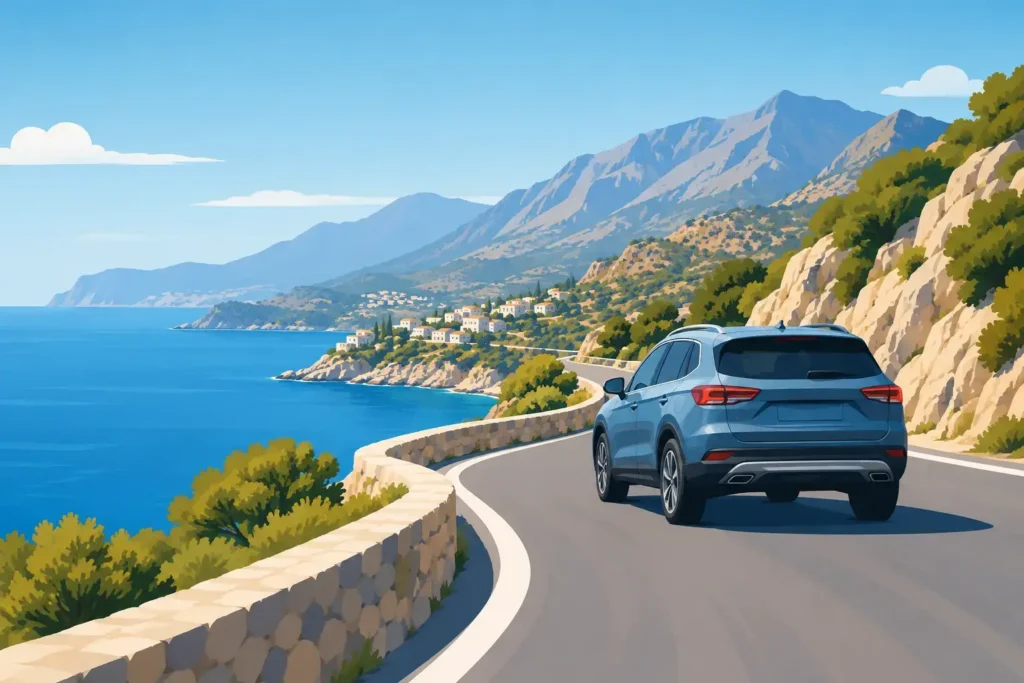
A large SUV can feel reassuring when you picture Crete’s mountains. On many island roads, however, extra width creates more stress than extra confidence. The best car size for driving mountain roads in Crete is usually a compact or small crossover: easy to place on narrow lanes, comfortable enough for day trips, and practical at hotels, villages, and beach parking areas.
The right answer still depends on who is traveling, where you plan to go, and how much luggage you have. Crete is a large island with modern highways, busy resort roads, steep village streets, and winding routes through the White Mountains, Psiloritis, and eastern hills. Choose for the roads you will actually drive, not just for the idea of a mountain vacation.
Why smaller cars work better on Crete’s mountain roads
Much of Crete’s mountain driving happens on paved roads, but paved does not always mean wide. You may meet a local pickup, tour bus, or delivery van around a blind bend. In older villages, stone walls, parked cars, and tight corners can leave little room to spare.
A compact car gives you better visibility of the road edges and makes passing situations less intimidating. It is also easier to park when you stop for lunch in a mountain village or pull into a small roadside viewpoint. Less vehicle width means less second-guessing on a narrow two-way road.
This does not mean you need the smallest vehicle available. A very small economy car can be perfectly capable for two people traveling light, but it may feel cramped on longer drives from Heraklion or Chania to the south coast. The sensible middle ground is usually a compact hatchback, compact sedan, or small crossover.
Best car size for driving mountain roads in Crete by trip type
Couples and solo travelers: economy or compact
For one or two travelers with light luggage, an economy or compact car is normally the easiest choice. It handles narrow roads well, uses less fuel, and fits into spaces that would challenge a larger vehicle.
Choose a compact rather than the very smallest category if you are planning several long day trips, carrying full-size suitcases, or want a little more power on uphill stretches. You do not need a large vehicle to visit places such as the Lasithi Plateau, mountain villages near Rethymno, or scenic roads above the south coast.
Two adults with more luggage: compact or small crossover
A small crossover is often the best balance for a couple carrying more than cabin bags. You gain a higher seating position, useful luggage room, and a more relaxed ride over uneven surfaces without taking on the size of a full SUV.
This category is a good fit if your itinerary includes a mix of airport driving, remote beaches, village stays, and mountain routes. It is also a sensible choice if you prefer easier entry and a bit more room without making parking difficult.
Families: compact crossover or midsize vehicle
Families should size the car around passengers, child seats, and bags first. A compact crossover can work well for two adults, one or two children, and normal vacation luggage. Before reserving, consider the real space taken by strollers, beach gear, and large suitcases. Those items fill a trunk quickly.
A midsize car may be worth it when you need two child seats or are staying in several places with a lot of luggage. Just keep the trade-off clear: the larger the vehicle, the more care you will need on tight mountain roads and in old-town parking areas.
Groups of four or more: choose space, then plan your route
For four adults with luggage, a larger vehicle may be necessary. Comfort matters, especially on a full-day drive. Still, do not choose a van-sized vehicle unless your group and bags genuinely require it.
Large vehicles are manageable on major roads and main routes, but they are not ideal for spontaneous detours through tiny villages. If you rent one, use established roads, allow more time for parking, and do not assume every scenic lane will suit its width.
Is an SUV necessary in Crete?
Usually, no. A standard rental car is enough for most popular mountain drives because the main routes are paved. A small SUV can be comfortable, but four-wheel drive is not automatically needed for a normal Crete itinerary.
The more relevant question is whether you intend to drive on unpaved roads. Many rough tracks lead to remote beaches, gorges, and isolated areas, but not every rental agreement allows off-road or unsuitable-road use. A vehicle with more ground clearance does not make every track safe, insured, or appropriate. Check the road condition, follow your rental terms, and turn back when a route becomes questionable.
For most visitors, a smaller car on a maintained road is safer than a larger SUV pushed onto a road it should not be on.
Manual or automatic for mountain driving?
If you are comfortable driving a manual, it gives you useful control on climbs and descents. Lower gears can help maintain a steady speed downhill instead of relying too heavily on the brakes. This is particularly helpful on long, twisting routes.
If you do not regularly drive a manual, choose an automatic. Vacation is not the time to relearn hill starts on a narrow road with a local vehicle waiting behind you. A confident driver in an automatic is safer than an anxious driver in a manual, regardless of car size.
Reserve early if an automatic is essential. They are popular with international visitors and availability can be more limited than manual vehicles during busy travel dates.
What matters more than car size
Car size matters, but calm driving matters more. Mountain roads in Crete reward patience. Use lower speeds before bends, stay right on narrow roads, and expect livestock, cyclists, pedestrians, and local drivers who know the route far better than you do.
Avoid rushing to reach a beach or taverna before sunset. GPS estimates can be optimistic on winding roads, and a short distance may take longer than expected. Start mountain drives with time to spare, keep fuel in the tank, and use a pull-off only where it is clearly safe.
Do not stop in the roadway for photographs, even if the view is spectacular. Find a designated viewpoint or a wide, safe area where your car will not block traffic. In villages, park only where permitted and be prepared to walk the final few minutes.
Choose coverage that matches the route
A narrow road, loose stones, and unfamiliar parking areas are exactly why clear rental coverage matters. Before pickup, know what is included and whether wheels, tires, glass, underside damage, and theft protection are covered for your vehicle category.
Do not focus only on the lowest online daily rate. A cheap-looking booking can become expensive when the actual insurance terms, exclusions, deposits, or add-ons appear at the counter. Direct local rental service should make the key conditions clear before you drive away.
AthensCars is built for this kind of practical travel: straightforward local pickup, payment on arrival, and comprehensive coverage options designed to reduce unpleasant surprises. Read the terms for your specific vehicle, then drive with the confidence that comes from knowing where you stand.
A practical choice for most visitors
If you want one simple recommendation, reserve a compact car for two people or a small crossover for a couple with larger luggage or a small family. These categories handle the widest range of Crete vacations well. They are comfortable for airport transfers and longer road trips, yet small enough for the island’s mountain bends and village streets.
Go larger only when passenger and luggage needs truly demand it. Go smaller if you are traveling light and value easy parking above all else. The best rental car is not the biggest one you can book. It is the one you can drive calmly, park confidently, and enjoy from the first mountain curve to the last village stop.
Before you set off, adjust your mirrors, save your accommodation details offline, fill up before remote routes, and give yourself more time than the map suggests. Crete’s best drives are better when you are free to slow down for them.