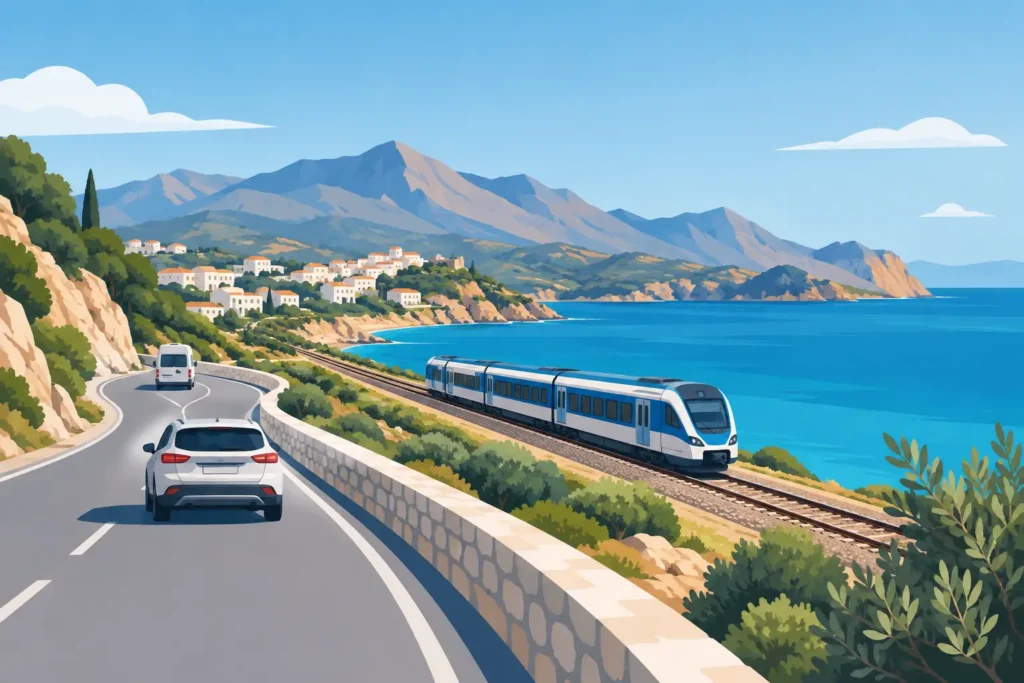
A train station will not be waiting outside Heraklion or Chania Airport. If you are asking, “is there a railway on Crete, or just vehicles?”, the practical answer is simple: Crete has no operating passenger railway. Visitors get around by rental car, public bus, taxi, private transfer, organized tour, scooter, or bicycle.
That matters because Crete is much larger than many first-time visitors expect. A map can make beaches, villages, archaeological sites, and mountain towns look close together. On the road, a route may involve winding sections, slow village traffic, and a long stretch between major destinations. Choosing the right transport before you arrive saves time, avoids expensive last-minute transfers, and gives you a better trip.
Is There a Railway on Crete or Just Vehicles?
There is no passenger train network on Crete and no rail connection between Heraklion, Chania, Rethymno, Agios Nikolaos, or the island’s airports. You cannot take a train from the airport to your hotel, ride rail to Knossos, or use one to reach the south coast.
Crete did have small industrial railways in the past, used for purposes such as moving goods around specific facilities. They were never a modern island-wide passenger system, and they are not a transportation option for travelers today.
So, while “just vehicles” is not the whole story - walking, boats, and tours also have their place - road transport is the backbone of getting around. The island’s travel system is built around roads, buses, and vehicles, not tracks.
Your Main Ways to Travel Around Crete
The best choice depends on where you are staying, how many places you want to see, and whether you are comfortable driving. There is no one answer for every vacation. A couple staying in Heraklion for a long weekend can manage very differently from a family splitting time between Chania, Rethymno, and Elounda.
Rental car: the most flexible choice
For most visitors, a rental car is the simplest way to see Crete properly. It lets you leave the airport or port when you are ready, stop at a village bakery, change plans when the weather shifts, and reach beaches that do not fit neatly into a bus timetable.
A car is especially useful if your itinerary includes more than one base. Heraklion to Chania is roughly a two-and-a-half-hour drive without long stops, while many south-coast routes take considerably longer than they appear on a map. With a vehicle, you can make those transfers on your own schedule rather than building the day around connections.
It also makes sense for families and groups. Luggage, child seats, beach bags, water, and groceries are easier to manage when you have your own space. Sharing the rental cost can also compare well with multiple private transfers.
The trade-off is that you need to drive responsibly. Parking in the busiest old-town areas can be limited, and some mountain or rural roads are narrow and require patience. Do not rush to a beach just because the navigation app shows a short distance. Allow extra time, avoid risky shortcuts, and choose a vehicle suitable for your group and luggage.
For travelers who want clear terms, AthensCars offers local pickup and drop-off across Crete, including airport, port, hotel, and city delivery. The practical advantage is straightforward: book before arrival, pay at handover, and know what insurance protection is included instead of discovering added costs at the counter.
Public buses: useful on popular routes
Crete’s intercity buses connect many major towns and can be a sensible option for travelers staying in one place. Routes commonly serve Heraklion, Chania, Rethymno, Agios Nikolaos, Hersonissos, and other popular areas. Buses are generally far more useful for town-to-town travel than for reaching isolated beaches or remote mountain villages.
This option works best when your hotel is near a central stop and your plans are uncomplicated. It can be economical, and you do not need to think about parking or driving after a long flight.
But buses operate on fixed schedules. Frequency changes by route and season, service can be limited in smaller places, and connections may take more time than expected. If you have a tight restaurant reservation, a flight to catch, or a list of places spread across the island, public transport can become restrictive quickly.
Taxis and private transfers: best for direct arrivals
A taxi or pre-arranged transfer is a good choice if you are arriving late, staying in one resort, or simply do not want to drive. It is direct and uncomplicated for an airport-to-hotel trip.
The limitation is cost and flexibility. A transfer solves one journey, not a week of exploring. Taking taxis repeatedly between beaches, villages, and attractions can become expensive, especially for longer distances or return trips from quieter areas. If you intend to leave your resort more than once or twice, compare the total transportation cost before deciding.
Organized tours: easy, but fixed
Day tours can be a good fit for famous destinations when you prefer not to drive. They remove the logistics of route planning and can provide useful historical context at places such as Knossos or other cultural sites.
The compromise is control. Departure times, stops, and time at each location are set for the group. A tour is convenient when you want one easy day out. It is less suitable if you want to linger at a beach, eat in a small village, or build your own route.
Planning Around Crete’s Roads
Without a railway, your accommodation location has a bigger effect on your vacation. Before booking, decide whether you want a relaxed stay in one area or a road trip with several stops.
For a first visit focused on museums, restaurants, Knossos, and central access, Heraklion can work well. Chania suits travelers who want an old harbor, west-coast beaches, and a lively city base. Rethymno is useful for a central position between the two. Eastern resorts near Agios Nikolaos or Elounda are convenient for that side of the island but are not close to Chania’s western beaches.
Trying to see all of Crete from one hotel is possible, but not always enjoyable. The island rewards a slower plan. A few well-chosen areas, with enough driving time allowed, will usually feel better than racing from one highlight to the next.
If you rent a car, confirm the practical details before booking: pickup point, fuel policy, child-seat availability, allowed drivers, and insurance coverage. The lowest advertised daily rate is not always the lowest final cost. Some third-party sites show a low starting price and add extras for insurance, luggage protection, or payment conditions later. Clear pricing and comprehensive coverage are worth more than a cheap number that changes at the desk.
What About Scooters, ATVs, and Bicycles?
Two-wheel options can be enjoyable for short local travel, but they are not automatically the easy alternative to a car. Summer heat, wind, traffic, distance, and luggage all matter. A scooter may be fine for moving around a resort area if you have the right license and experience. It is not the best answer for a family arrival at the airport or a multi-day route across the island.
ATVs are popular in some tourist areas, yet they offer less weather protection, less luggage room, and less comfort on long routes. Use any small vehicle only within your confidence and licensing requirements. A vacation is not the place to learn how to handle unfamiliar mountain roads.
Bicycles are excellent for dedicated riders and short scenic routes, but Crete’s hills and summer temperatures make them a specialist choice rather than general transportation.
The Simple Answer for Your Crete Trip
Crete has no passenger railway, so plan your transportation around the road network from the beginning. Use a bus if you are staying central and traveling between major towns. Use a transfer if you only need airport-to-hotel transportation. Choose a rental car when you want beaches, villages, flexible stops, and the freedom to shape each day yourself.
The best Crete itinerary is not the one with the most pins on a map. It is the one that leaves enough room to pull over for a view, stay longer where you are happy, and get back to your hotel without worrying about the last bus.