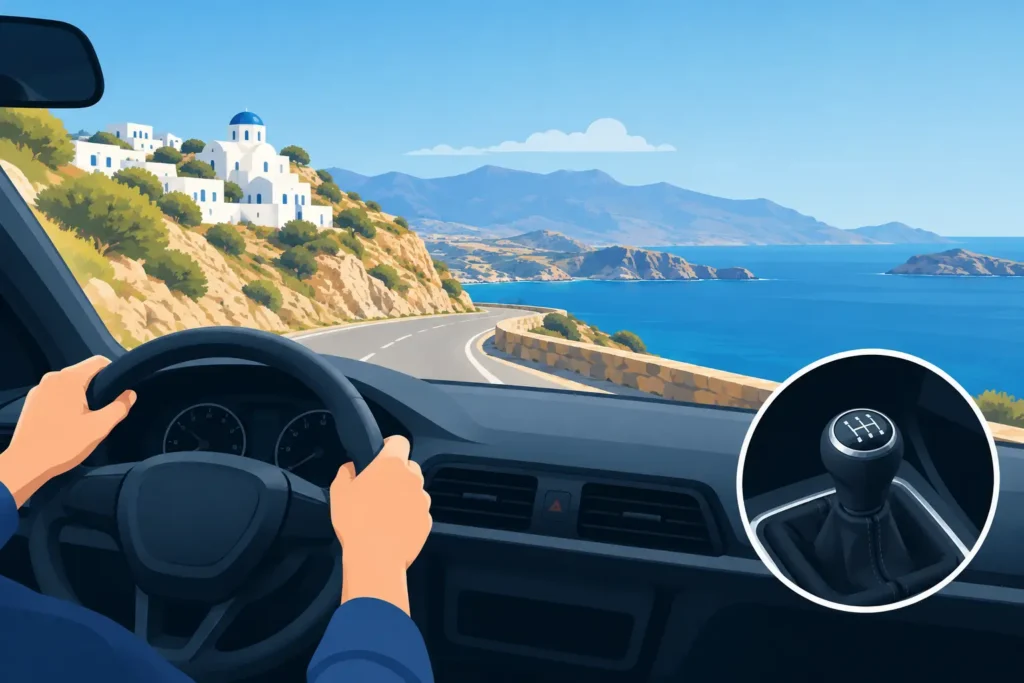
A manual gear car for Crete can be a smart, economical choice - but only if you are genuinely comfortable driving one. Crete is not a place to relearn clutch control after years of driving automatics. The island rewards independent travelers with remote beaches, mountain villages, archaeological sites, and tavernas well beyond the main resorts. It also has steep roads, tight parking areas, sharp turns, and summer traffic that can test an uncertain driver.
The right rental is the one that lets you enjoy the drive rather than worry about it. For some visitors, that means a compact manual car with good fuel economy. For others, especially families or drivers arriving after a long flight, an automatic is worth the extra cost. Here is the practical way to decide before you book.
When a Manual Gear Car for Crete Makes Sense
A manual transmission works well for travelers who drive stick regularly and plan to stay mainly on paved roads. If you are comfortable starting on hills, selecting the right gear on descents, and handling stop-and-go traffic, a manual car can be a simple, capable option for a Crete vacation.
Manual rentals are often available in smaller vehicle categories. That can be useful on the island, where a compact car is easier to place on narrow village streets and in limited hotel parking. A smaller vehicle also uses less fuel, which matters if your plan includes long drives between Heraklion, Chania, Rethymno, Agios Nikolaos, and the south coast.
The biggest advantage is control. On a winding uphill road, a confident manual driver can choose the gear that keeps the engine responsive. On a long downhill section, using a lower gear can help control speed and reduce reliance on the brakes. This is normal driving practice, not a reason to seek out difficult roads. Crete has plenty of beautiful routes that are fully paved and suitable for ordinary rental cars.
A manual is also a good fit if every listed driver is comfortable with it. Do not assume your travel partner can take over if you are tired, unwell, or want to enjoy a glass of wine with dinner. If only one person can drive manual, your trip has less flexibility.
When an Automatic Is the Better Vacation Choice
Choose an automatic if you have not driven a manual car recently, dislike hill starts, or simply want less to manage. This is especially true if you are collecting the car at Heraklion or Chania Airport after an overnight flight. A vacation should not begin with stalled starts in an unfamiliar parking area.
Automatics are also often the easier choice for families. If you are navigating with children in the back seat, dealing with luggage, finding a hotel, and following directions through an unfamiliar town, removing clutch work can make a noticeable difference. The same applies to friend groups where several people may share driving duties.
Do not book a manual purely because it is cheaper online. A low daily rate stops being a good deal if the car feels stressful for the person behind the wheel. The cost difference between transmission types should be weighed against your route, confidence level, and how much driving you expect to do.
There is no prize for choosing the more difficult option. The best car is the one you can operate calmly on day one, in traffic, on an incline, and after a long day at the beach.
Crete Roads: What Actually Changes the Decision
Crete is a large island, and its roads vary widely. The national road along the north coast connects major cities and is generally straightforward, though traffic can be busy near urban areas and resort zones. A manual car is not difficult there for an experienced stick-shift driver.
The decision becomes more relevant away from the main road. Mountain routes can be narrow, curved, and steep. Villages may have streets built long before modern traffic, with parked cars narrowing the available space. In popular destinations, parking can involve slopes, tight turns, or short walks from the nearest available spot.
Road conditions also require common sense regardless of transmission. Keep your speed appropriate for the bends, leave room for local traffic, and do not assume every map route is suitable for every vehicle. Some roads lead to unpaved tracks or rough access points. Standard rental insurance may have conditions around driving off paved roads, so ask before you go if your plans include isolated beaches or mountain areas.
A manual transmission does not make a car better for rough roads. Ground clearance, vehicle category, tire condition, and permitted use matter far more. Never treat a standard compact rental as an off-road vehicle.
Check These Details Before Booking
Transmission is only one part of choosing a rental car in Crete. Before you reserve, confirm the vehicle category and the conditions that affect your trip. Four details deserve particular attention:
- Transmission confirmation: Make sure the reservation clearly says manual or automatic. Do not rely on a vehicle photo alone. A picture may show a model example, while availability is based on category.
- Insurance terms: Look for clear wording on comprehensive coverage, excess, glass, tires, wheels, underside, theft, and accident procedures. “Cheap” rates can become expensive when protection is unclear.
- Pickup and payment: Confirm where the car will be delivered, when payment is collected, whether a credit card is required, and how airport or port handover works.
- Driver rules: Check the minimum age, license requirements, additional-driver policy, child-seat availability, and whether your license is valid for the rental period.
These are not small-print details. They determine whether you arrive relaxed or spend your first hour sorting out a surprise deposit, a payment restriction, or a vehicle that does not match your needs.
AthensCars keeps the process direct: book in a few clicks, pay when you receive the vehicle, and choose coverage with no excess where available for your category. That straightforward approach matters most when you are arriving with luggage and a schedule, not looking to negotiate conditions at a counter.
Driving a Manual Safely on the Island
If you choose a stick shift, take five minutes at pickup to become familiar with the car. Check the clutch bite point, reverse gear position, handbrake, mirrors, lights, air conditioning, fuel type, and the location of the warning triangle or emergency equipment. Every vehicle feels slightly different, even to experienced manual drivers.
On descents, select a suitable lower gear before the slope becomes steep. Avoid coasting in neutral. On climbs, leave extra space behind the vehicle ahead so you do not need to stop and restart unnecessarily. If you need to park on an incline, use the parking brake properly and turn the wheels appropriately for the slope.
Keep in mind that many roads have blind bends and limited shoulders. Local drivers may know the route well and travel faster than visitors should. Let faster traffic pass when it is safe, stay on your side of the road, and do not let a car behind you pressure you into taking a corner too quickly.
Fuel stops should be planned rather than left until the warning light is on, particularly if you are heading into the mountains or toward a quieter south-coast area. And if a warning light appears, a tire is damaged, or you have an accident, contact the rental company promptly. Fast local support is more useful than trying to solve an unfamiliar problem alone.
The Simple Rule for Choosing Your Transmission
Book a manual if you drive one confidently at home, want a compact and efficient car, and are comfortable with hills and narrow roads. Book an automatic if you are rusty, sharing driving with automatic-only drivers, traveling with children, or want the least demanding experience possible.
Crete is best seen with the freedom to stop when a sign points to a village, a beach road looks promising, or lunch runs later than planned. Choose the car that makes those moments feel easy, then focus on the road ahead and the places you came to see.