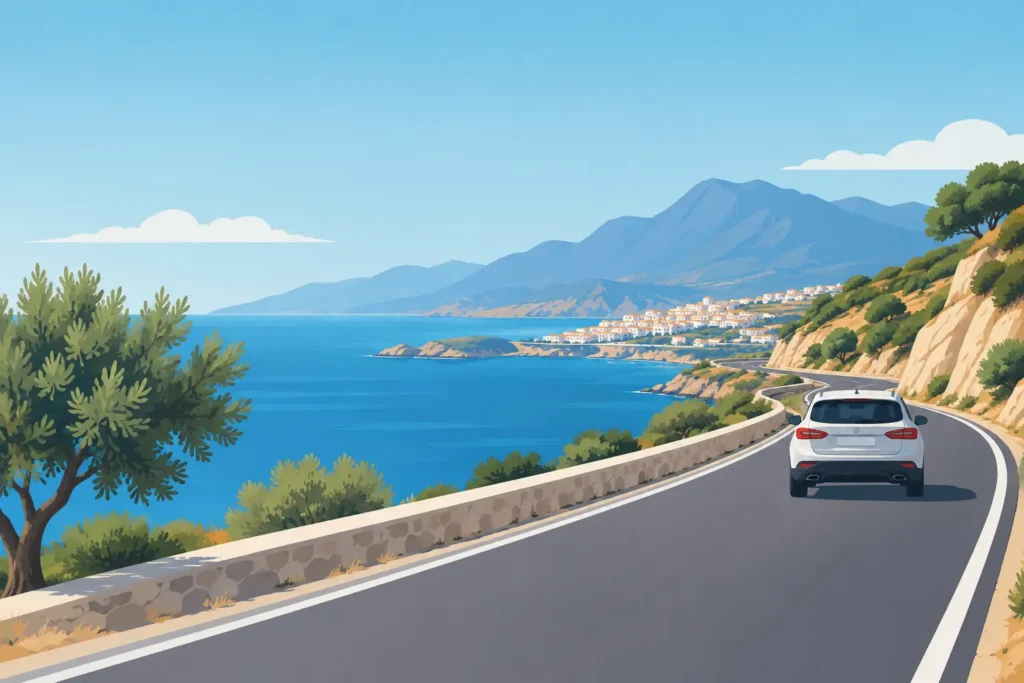
You can collect your rental car at Heraklion Airport and be on the road within minutes, but the first thing to remember is this: what is the max speed on Crete's roads? The short answer is that it depends on the road and, above all, the signs. Crete is not a place to set cruise control at the national maximum and forget about it. Mountain curves, village traffic, changing road surfaces, and frequent lower limits all demand attention.
For most vacation driving, expect to travel more slowly than you might at home. That is not a problem. It is the sensible way to enjoy the island, arrive safely, and avoid an expensive fine or a stressful incident.
What Is the Max Speed on Crete's Roads?

Under Greece's general road rules, the maximum speed can be up to 130 km/h (about 81 mph) on designated motorways where signs allow it. However, this is not the speed you should expect to drive on ordinary routes around Crete.
On many roads outside towns and villages, the usual general limit is 90 km/h (about 56 mph), unless a sign states otherwise. In built-up areas, the standard limit is commonly 50 km/h (about 31 mph). Certain major divided-road sections may have higher posted limits, often 110 km/h or occasionally more, but the sign at the roadside is always the rule that matters.
Crete's main northern route, commonly known as the BOAK or Northern Road Axis, is not one uninterrupted motorway. It includes different road types, junctions, narrow sections, construction areas, and stretches with local restrictions. You may see 90 km/h, 80 km/h, 70 km/h, or lower limits depending on the exact section. Do not assume that a wide-looking road has a higher legal limit.
If you remember only one rule, make it this: follow the posted speed limit, not the speed of the vehicle in front of you.
The Speeds You Will Most Often See
For a practical reference, these are the numbers visitors should know before driving in Crete:
- 50 km/h (31 mph) is typical in towns, villages, and built-up areas.
- 90 km/h (56 mph) is a common maximum on open roads outside populated areas.
- 110 km/h (68 mph) may apply on certain higher-standard divided-road sections when clearly signed.
- 130 km/h (81 mph) is Greece's top motorway limit, but it applies only on designated motorway sections with signs permitting it.
Temporary signs override every general rule. Roadworks, sharp bends, schools, town entrances, rain, and damaged pavement can all bring the legal speed down. A 30 km/h or 40 km/h sign near a village is not a suggestion, even if the road appears quiet.
Why Crete Often Requires a Lower Speed
Crete rewards drivers who leave extra time in the plan. A route that looks short on a map can take longer than expected because the road climbs, bends, narrows, or passes directly through small villages.
The drive from Heraklion to Chania on the north coast is generally straightforward compared with mountain routes, but it still has changing speed limits, busy exits, and traffic around larger towns. Once you head south toward Matala, Plakias, Paleochora, Elafonissi, or mountain villages, the character of the drive changes quickly. Roads may be narrow, have no center line, and include blind turns where two vehicles cannot pass easily.
Keep an eye out for scooters, cyclists, pedestrians, farm vehicles, and animals. Goats are not unusual on rural roads. In summer, strong sunlight can make it harder to see into a bend; after rain, dusty or polished road surfaces can become slippery. At night, poor lighting and unfamiliar curves make lower speeds even more sensible.
The fastest legal speed is rarely the safest speed. On a winding mountain road, 40 km/h may be completely appropriate even if the posted maximum is higher.
Passing and Local Driving Habits
Visitors sometimes notice local drivers moving quickly on familiar roads. Do not feel pressured to copy them. Keep a predictable pace, stay focused on your lane, and use the right side of the road.
On some wider two-lane routes, local drivers may move slightly toward the right edge to allow faster vehicles to pass. This is a common local practice, but it does not mean you should drive on the shoulder or take risks. If it is safe, maintain your line close to the right and let a faster vehicle pass when there is room. Never pull abruptly toward the edge, especially where the shoulder is broken, uneven, or occupied by pedestrians and scooters.
Overtake only when you have a clear view, enough distance, and no solid center line or sign prohibiting it. A scenic road can create false confidence: what looks open from your position may hide a bend, a driveway, or an oncoming vehicle.
Speed Cameras, Fines, and Rental Car Responsibility
Speed limits in Crete are enforced. Police checks can occur on major roads and around towns, while cameras may operate in selected areas. A traffic ticket is the driver's responsibility, including when the vehicle is a rental car.
More importantly, speeding can turn a minor holiday driving mistake into a serious accident. Comprehensive rental coverage is there to reduce worry when the unexpected happens, but it does not make illegal or reckless driving acceptable. Serious traffic violations, driving under the influence, unauthorized drivers, and behavior outside the rental agreement can affect coverage. Read your rental terms, use only approved drivers, and treat every speed sign as part of protecting yourself, your passengers, and your vacation budget.
At AthensCars, the goal is simple: clear rental terms, no hidden costs, and dependable local support when you need it. Your part is just as simple - drive within the law and give Crete's roads the respect they require.
A Simple Plan for Driving at the Right Speed
Before setting off, use your map app to estimate travel time, then add a margin for stops, parking, and slower roads. Do not plan a beach day around an arrival time that requires rushing. A relaxed schedule makes better decisions much easier.
When you enter a village, slow down before the first houses. Watch for speed-limit signs after roundabouts, intersections, roadworks, and changes in road width. When descending a steep road, use a lower gear rather than relying only on the brakes. This gives you more control and avoids overheating brakes on long downhill sections.
If another driver is close behind, stay calm. Continue at a safe legal speed and allow them to pass at the next safe opportunity. Your rental car does not need to win a race to Balos, Knossos, or your hotel.
Questions Visitors Often Ask
Is 130 km/h allowed everywhere on Crete?
No. Although 130 km/h is Greece's top limit for designated motorways, it is not a blanket limit for Crete. Most visitors will encounter lower signed limits, particularly on the main northern road, village approaches, coastal roads, and mountain routes.
Can I use miles per hour instead of kilometers per hour?
Road signs and your rental car's main speedometer markings use kilometers per hour. If you normally drive in miles, remember the key conversions: 50 km/h is about 31 mph, 90 km/h is about 56 mph, and 130 km/h is about 81 mph.
Do speed limits change in bad weather?
A posted limit remains the maximum, not a target. Rain, high winds, fog, darkness, or heavy traffic may require a much lower speed. If visibility or grip is reduced, slow down early and leave more space from the car ahead.
A good Crete road trip is not measured by how quickly you cross the island. Leave room for the curves, the village stops, and the views - and you will get where you are going with far less stress.